
Transform raw analytics into actionable UIs. Drive operational efficiency using data-first development and human-centred design.
Key Takeaways
-
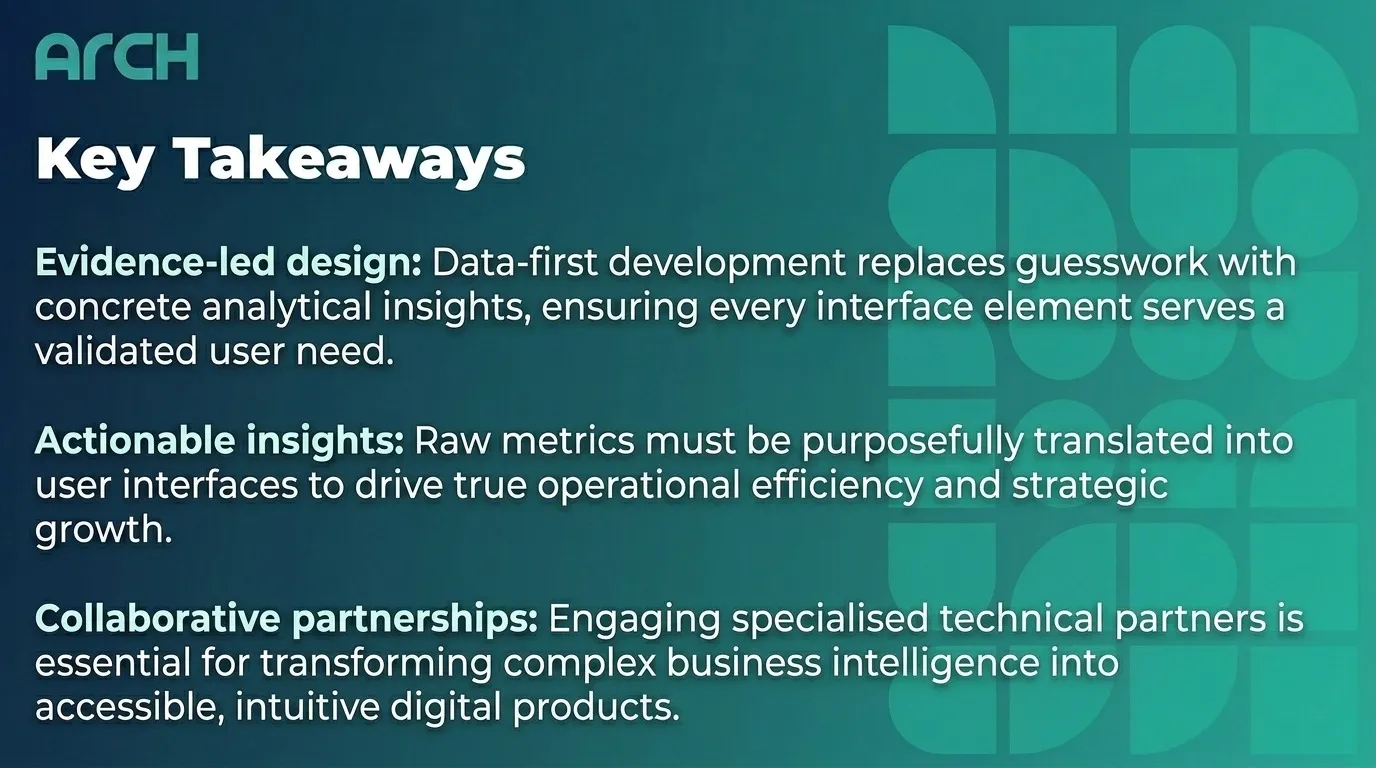
Evidence-led design: Data-first development replaces guesswork with concrete analytical insights, ensuring every interface element serves a validated user need.
-
Actionable insights: Raw metrics must be purposefully translated into user interfaces to drive true operational efficiency and strategic growth.
-
Collaborative partnerships: Engaging specialised technical partners is essential for transforming complex business intelligence into accessible, intuitive digital products.
Beyond the Dashboard: The Evolution of Design
In today’s highly digitised business landscape, modern organisations are inundated with vast quantities of raw analytics. However, possessing data and actually extracting value from it are two entirely different challenges. Without a clear strategy to translate these numbers into meaningful digital experiences, business intelligence often remains trapped within complex, inaccessible dashboards.
The true value of this information is only unlocked when it directly informs the way end-users interact with digital platforms. This is the essence of data-first development, a methodology that prioritises analytical evidence over subjective intuition. By embracing this purposeful approach, impact-driven teams can build applications that respond organically to actual user behaviour.
To achieve this seamlessly, organisations are increasingly relying on collaborative expert partners to bridge the divide. Translating dense statistical metrics into clean, human-centred interfaces requires both technical rigour and deep design empathy to ensure successful technological advancement.
The Shift from Intuition to Analytical Evidence
Historically, interface design relied heavily on industry best practices and the subjective preferences of key stakeholders. While this approach occasionally yielded beautiful software, it frequently failed to solve the practical, day-to-day problems faced by end-users. Today, the sheer volume of available metrics allows organisations to meticulously analyse workflows and pinpoint exactly where friction occurs.
By examining historical user paths, error rates, and task completion times, development teams can reliably identify systemic bottlenecks. This quantitative foundation provides an indisputable baseline for what needs to be improved, removed, or entirely reimagined within a digital product. It ensures that every development hour is spent addressing genuine user needs rather than perceived ones.
Moreover, this analytical rigour transforms digital projects from speculative investments into highly measurable operational upgrades. When design decisions are rooted in past performance data and verified behaviour, the resulting application is far more likely to deliver tangible, sustainable business value.
Translating Raw Metrics into Human-Centred UI
Having access to rich analytical data is merely the first step in the development journey. The critical next phase involves converting those abstract numbers into structural design choices that feel natural to the target audience. This requires a delicate balance of robust technical capability and an uncompromising focus on human-centred innovation.
It is during this translation phase that professional collaboration becomes vital to the project’s success. Partnering with a skilled app developers ensures that raw business intelligence is expertly woven into the very fabric of the application. These expert partners possess the cross-disciplinary skills required to align complex data architectures with elegant front-end experiences.
For instance, if analytics reveal that users routinely abandon a multi-step compliance programme at a specific hurdle, the interface must adapt accordingly. The solution might involve breaking down the data-entry requirements, introducing dynamic validation, or optimising the layout to reduce cognitive load. The data highlights the problem, but the user interface provides the actionable resolution.
Fostering Operational Efficiency Through Optimised Design
When interfaces are built specifically to accommodate proven user behaviour, the immediate result is a dramatic increase in operational efficiency. Employees spend significantly less time navigating clunky menus and more time executing core, value-driving tasks. Over time, these micro-efficiencies compound, resulting in vital resource savings and a higher overall standard of work.
Data-first interfaces also facilitate much clearer decision-making for the users themselves. By surfacing the most relevant information exactly when it is required, the system acts as an active, intelligent participant in the user’s workflow. The interface does not simply display raw data; it contextualises it, making complex insights instantly actionable.
Ultimately, this purposeful design philosophy positions technology as a transparent enabler rather than an operational obstacle. When digital tools are deeply informed by past interactions and validated metrics, they naturally evolve alongside the growing, ambitious demands of modern organisations.
Conclusion
Bridging the gap between raw analytics and actionable user interfaces is no longer an optional luxury; it is a critical strategic necessity. By adopting a dedicated data-first approach, modern organisations can strip away operational inefficiencies and build digital tools that are fundamentally aligned with real human behaviour. The transformation from static numbers to intuitive, high-performance design requires a deep commitment to both analytical truth and user empathy.
As business intelligence systems continue to grow in complexity, the importance of collaborative, expert-led development will only increase. By uniting robust data strategies with purposeful user interface design, companies can confidently deploy digital platforms that consistently drive both operational excellence and long-term strategic growth.
Frequently Asked Questions
What defines data-first development? Data-first development is a methodology where historical analytics, user metrics, and business intelligence serve as the foundational blueprint for creating software. Instead of relying on creative intuition alone, both design and functional decisions are strictly dictated by proven user behaviour.
How does a data-first approach improve user interfaces? By rigorously analysing how users interact with existing systems, developers can easily identify bottlenecks and friction points. This concrete evidence allows teams to optimise layouts, simplify complex workflows, and surface critical information, resulting in highly intuitive interfaces.
Why is it important to partner with specialists for this process? Translating complex data analytics into clean, accessible software requires a highly unique blend of data science and UX/UI expertise. Specialised expert partners provide the specific technical capability necessary to turn raw metrics into tangible, human-centred digital experiences.