
Key Takeaways
- Choose a saw based on the materials, stock sizes, cut types, and workload your shop handles most often.
- Horizontal band saws are usually best for repeated straight cuts, while vertical models are better for curves and contours.
- Blade speed, tooth pitch, workholding, and machine rigidity can matter as much as motor horsepower.
- Plan for loading space, long stock, chip cleanup, maintenance access, and operator safety before buying.
- The best saw is not necessarily the largest machine. It is the one that supports reliable, efficient daily work.
Choosing a metal-cutting band saw is easier when you start with the jobs your shop performs every week rather than the largest machine specification in a catalog. A repair shop that cuts occasional brackets, pipe, and bar stock has different needs than a fabrication operation making hundreds of repeat cuts per day.
For example, a vertical band saw can be a practical choice for shaping irregular parts, cutting curves, and making notches. A horizontal saw may be the better fit when the work involves preparing consistent lengths of tubing, structural material, or solid bar.
Why the Right Saw Choice Matters
The wrong machine can create problems long after the purchase. Cuts may take too long, blades may wear out prematurely, material can shift in the vise, and rough-cut ends can add unnecessary finishing work. Reviewing metal-cutting saw features can help buyers understand the differences in cutting control, portability, debris handling, and material capability across saw styles.
The right choice depends on what you cut most often. Steel, stainless steel, aluminum, solid rounds, thin-wall tubing, and structural shapes do not all respond the same way to speed, feed pressure, tooth pitch, and coolant. A saw should fit the normal workload first, while still leaving reasonable room for occasional larger jobs.
Match the Saw to the Work
A saw should fit your work schedule, not merely the dimensions of one part. Small shops often need flexibility because the work changes from day to day. Higher-volume shops may place more value on repeatable lengths, fast loading, and dependable cycle times.
Questions to Ask First
- Which five materials will the saw cut most often?
- What are the largest round, square, rectangular, and irregular workpieces?
- Will most cuts be straight, angled, curved, or internal?
- How many cuts are required during a typical day or shift?
- Will the saw remain stationary or need to move around the facility?
- Will the cutting volume justify coolant and a dedicated chip-management routine?
Horizontal vs. Vertical Band Saws
When a Horizontal Saw Makes Sense
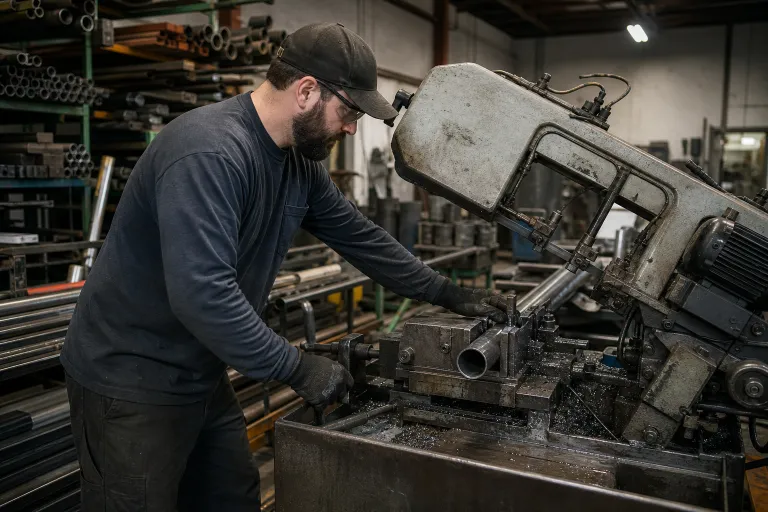
Horizontal saws are commonly used for repeated straight cuts through pipe, tube, bar, and structural stock. The material stays secured in a vise while the saw head lowers through the workpiece. This setup supports batch cutting, consistent lengths, and efficient stock preparation. Gravity feed or controlled feed can also reduce the amount of hands-on attention needed during a cut.
When a Vertical Saw Makes Sense
Vertical saws are better suited to curved profiles, notches, slots, and irregular shapes. The operator guides the material across the table, which makes these machines useful for custom fabrication and smaller parts. A combination machine can offer flexibility, but a dedicated horizontal or vertical model often delivers better results when one cutting style dominates the workload.
Check Cutting Capacity and Power
Compare capacity to the largest workpieces your shop regularly handles, not just once in a while. Look at maximum round capacity, square and rectangular capacity, throat depth on vertical models, vise opening, blade dimensions, and available miter settings. Leave enough room for clamps and awkward material shapes, but avoid spending heavily on unused capacity.
Motor horsepower matters, but it is not the only measure of performance. Blade condition, feed rate, blade tension, guide adjustment, machine rigidity, and secure workholding all influence cut quality. A properly set up, appropriately sized saw can outperform a larger machine that uses the wrong blade or is poorly aligned.
Compare Blade Speed and Tooth Pitch
Blade speed is usually measured in feet per minute. Softer metals can often be cut at faster speeds, while harder materials generally require slower speeds and better heat control. Variable speed is especially useful for shops that move between aluminum, mild steel, stainless steel, and different stock thicknesses.
Blade Selection Factors
- Bimetal blades are common for general metal cutting and a variety of shop work.
- Carbide blades may be worthwhile for demanding materials or higher-volume production.
- Variable-pitch blades can reduce vibration when cutting mixed profiles.
- Blade width affects curve-cutting ability and overall stability.
- Tooth pitch should match material thickness and shape.
As a practical rule, keep several teeth engaged with the workpiece throughout the cut. Too few teeth can create shock loading and tooth damage. Too many teeth can reduce chip clearance, slow cutting, and encourage chip packing.
Plan Around Workflow and Floor Space
Machine placement directly affects productivity and safety. Leave clear space for incoming stock, completed pieces, operator movement, blade changes, and service work. Also consider electrical requirements, lighting, coolant collection, and access to controls. In a compact shop, a smaller saw with easy loading may be more useful than an oversized machine that blocks a main aisle.
Review Safety Features
Before purchase and installation, inspect blade guards, pulley covers, adjustable guides, emergency-stop controls, blade tension systems, brakes, and vise design. OSHA’s band saw safety guidance emphasizes proper guarding, guide adjustment, blade tension, and safe work practices.
- Keep guards installed and positioned close to the workpiece.
- Clamp stock securely before beginning a cut.
- Keep your hands clear of the blade path and moving material.
- Wait for the blade to stop before clearing offcuts.
- Use appropriate eye and hearing protection.
- Train every operator on setup, shutdown, and blade replacement.
Account for Maintenance and Operating Costs
The purchase price is only part of the ownership cost. Budget for replacement blades, coolant, filters, lubricants, electrical service, training, and downtime. Routine maintenance should include checking blade tension and tracking, inspecting guides and bearings, removing chips, monitoring coolant condition, and verifying vise alignment.
A consistent maintenance schedule helps prevent avoidable blade failures and makes alignment issues easier to identify before they affect an entire batch of parts. Replacing a worn blade early is often less costly than accepting poor cuts, excess burrs, and wasted material.
Use a Pre-Purchase Checklist
- List the materials your shop cuts most often.
- Measure the largest regular workpiece and account for clamping needs.
- Record average cuts per day and expected production peaks.
- Decide whether straight cutting or contour cutting is more important.
- Compare blade speed ranges, blade availability, and tooth-pitch options.
- Confirm floor space, power, coolant, and material-handling requirements.
- Review guarding, emergency controls, and operator training needs.
- Estimate first-year costs for blades, maintenance, and consumables.
Common Questions
What type of band saw is best for straight metal cuts?
A horizontal band saw is often the practical choice for repeated straight cuts through bar, pipe, tubing, and structural material because the stock can remain clamped in a vise.
Are variable speeds worth having?
Yes, especially for shops that cut several metals or switch between thin-wall and solid stock. Adjustable speed gives operators more control over heat, blade life, and cut quality.
How much extra capacity should a buyer allow?
Allow enough room above your largest regular workpiece for clamps, future jobs, and practical loading. Avoid paying for extreme capacity that will rarely be used.
How often should a band saw blade be replaced?
Blade life varies with material, pitch, coolant, feed pressure, alignment, and cutting volume. Replace a blade when cuts become inconsistent, excessive force is needed, teeth are damaged, or the blade no longer tracks reliably.
Final Thoughts
The right metal-cutting band saw supports your shop’s materials, work volume, available space, and safety practices. Focus on real cutting capacity, blade options, workflow, workholding, and operating costs. That approach will usually lead to a better long-term decision than choosing a machine based on motor size or price alone.